What 15,675 flagged issues across 727 takeoffs reveal about the real risks in electrical estimating, and the documents where dollar exposure actually concentrates.
Free PDF. We will email it to you in 30 seconds.
Every estimator has shipped a bid only to find out, two weeks later, that a general note added $40,000 in scope. Or that the spec called for copper feeders and they priced aluminum. These aren't rookie mistakes. They happen on complex jobs because the information was scattered across documents that were never designed to be read together.
Missing a physical item on a drawing averages $3,772 in exposure. Missing a sentence buried in the documents averages two to three times that. Sentence-level issues are harder to catch because they require reading across multiple disciplines and cross-referencing information that was never organized for the estimator.
Average exposure when an estimator misses something visible: an outlet, a junction box, a fixture. These are the items takeoff software is designed to count, and the items most estimators feel confident about.
Average exposure when a spec clause, a general note, or a coordination requirement slips through. These live across multiple documents and rarely show up on the electrical sheets.
Electrical estimators work primarily from the E-series sheets. But nearly a third of all project notes in Makeoff's dataset originate from non-electrical disciplines, where coordination requirements, outlet locations, and power provisions hide.
"These drawings were terrible. There's always conflicts between architectural and mechanical. Sometimes the PVC is in the notes with an arrow."
— Estimator interview · Makeoff user research
The top 25 most-missed items are overwhelmingly general requirements and code compliance items, not physical fixtures. They live in Division 01 and the spec book, never on the electrical plan sheets.
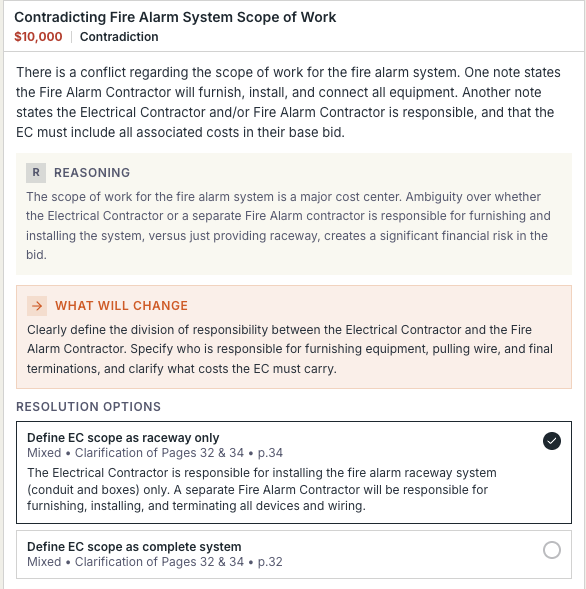
Makeoff reads every discipline, every page, every note. It flags the contradictions, surfaces the buried scope, identifies the code gaps, and catches the coordination issues that fall between trades. The result isn't a faster takeoff, it's a more defensible bid.
Drawings, specs, addenda, RFIs, every discipline. Nothing gets skimmed.
Notes from architectural, mechanical, plumbing, civil are linked back to electrical scope.
When the spec says copper and the drawing says aluminum, you know before bid day.
Every flagged issue is sourced to a page and a line, ready for the bid review.
Get the full data report, plus a 30-day pilot of Makeoff on your next two bids.
And someone from Makeoff will reach out about a pilot.